If you've been paying attention to digital marketing lately, you've probably noticed three acronyms showing up everywhere: SEO, AEO, and GEO. They sound similar. They're often mentioned in the same breath. And if you're a business owner trying to figure out what any of them actually mean for your bottom line, the jargon can feel overwhelming.
This post is going to cut through it — no marketing fluff, no technical rabbit holes. Just a clear explanation of what each term means, how they're different from each other, and which ones your business should be investing in right now.
A few years ago, "getting found online" meant one thing: ranking on Google. You hired someone to do SEO, your page climbed up the results, and customers clicked through to your website.
That model is changing — fast.
Gartner predicted that traditional search engine volume would drop 25% by 2026, with search marketing losing market share to AI chatbots and virtual agents. That prediction has now arrived at its target date, and the data confirms it's tracking close to actual numbers.
The reason is simple: people are changing how they search. Instead of typing "best plumber Kennewick WA" into Google and scrolling through results, they're asking ChatGPT "who should I call for an emergency pipe repair tonight?" and getting a direct answer with business names.
ChatGPT processes 2.5 billion prompts daily, 65% of which qualify as search queries. Those aren't people browsing — those are people looking for answers, recommendations, and businesses to hire.
This shift is why SEO alone isn't enough anymore — and why AEO and GEO exist.
What it is: Search Engine Optimization is the practice of improving your website and online presence so that it ranks higher in traditional search engine results — primarily Google.
What it involves: Keywords, backlinks, page speed, mobile optimization, content quality, technical site health, meta tags, internal linking — all the things that tell Google your page deserves to rank for a given search term.
What it does for your business: When someone Googles "HVAC repair near me" and your website appears at the top of the results, that's SEO working.
Is SEO dead? No — and anyone saying otherwise is wrong. Traditional SEO as a broader discipline — building brand authority, earning citations, and maintaining technical quality — is more important than ever. What's declining is the value of ranking a page purely for informational queries, where AI Overviews now resolve searches without the user ever clicking a link.
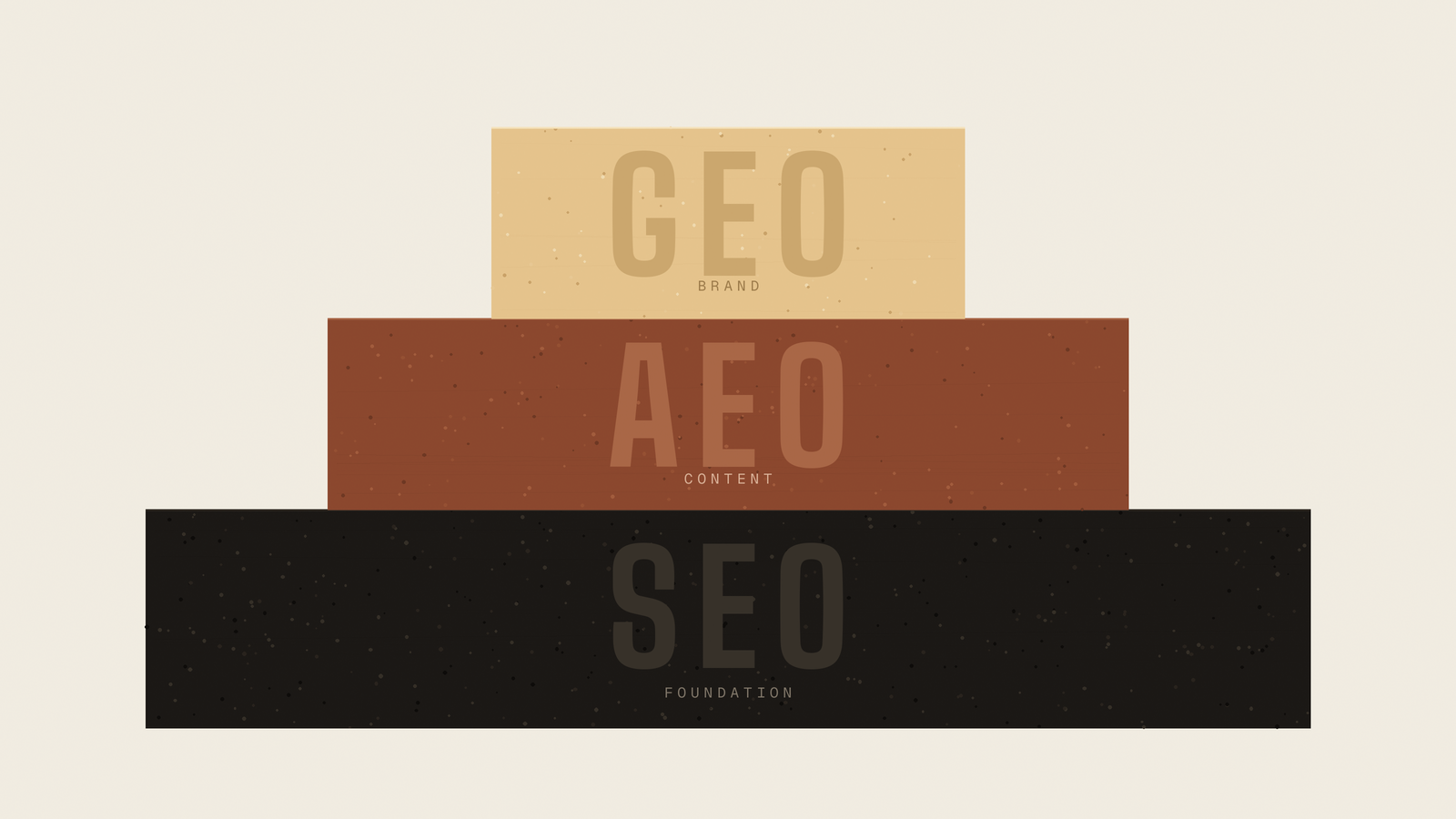
The practical reality: SEO is your foundation. Without it, neither AEO nor GEO can function properly. Think of it as the ground floor — you can't build the second and third floors without it.
What it is: Answer Engine Optimization is the practice of structuring your content so that AI search engines, voice assistants, and Google's featured snippets can extract it as a direct answer to a user's question.
The key distinction from SEO: SEO tries to get a user to click your link. AEO tries to get your content used inside the answer — whether or not the user ever visits your site.
AEO focuses on making content easily extractable as direct answers. When users ask questions, AEO-optimized content gets selected for featured snippets, voice search responses, and AI answer boxes. In 2026, most searches are resolved instantly, so AEO ensures your content appears inside AI responses and featured summaries.
What it looks like in practice: Instead of writing a paragraph that mentions plumbing services, you write a clearly formatted Q&A:
Q: How much does it cost to fix a burst pipe in Kennewick, WA?
A: Emergency pipe repair in Kennewick typically costs between $150 and $500 depending on the severity, location of the break, and time of day. Most repairs can be completed same-day.
That format — specific, direct, locally relevant — is exactly what AI engines extract when they form an answer. Your content becomes the source material for the response, even when your business name isn't mentioned.
What AEO does for your business: It gets your content inside the answer rather than just below it. For voice searches ("Hey Siri, find an electrician near me"), AEO is especially critical — voice results almost always pull from featured snippets and structured content.
What it is: Generative Engine Optimization is the practice of building your brand's authority and trustworthiness so that AI engines like ChatGPT, Perplexity, Claude, and Gemini recommend your specific business by name when someone asks for a recommendation.
GEO is the practice of shaping your content and your brand's online presence so that AI tools like ChatGPT, Gemini, Perplexity, and Claude actually mention or cite you when someone asks a question in your category. Unlike a traditional search engine, which hands back a list of ten blue links, a generative engine reads across dozens of sources and writes one synthesized answer.
The key distinction from AEO: AEO gets your content extracted as an answer. GEO gets your business recommended as the answer. It's the difference between your information showing up and your name showing up.
A key shift often overlooked: GEO is 80% strategic — positioning, ecosystem presence, brand authority — and only 20% technical. That means GEO isn't primarily about your website. It's about everything that surrounds your business online: your reviews, your directory listings, your third-party mentions, your consistency across platforms.
What GEO looks like in practice: When someone asks ChatGPT "who is the most reliable HVAC company in Pasco, WA?", the AI synthesizes reviews, directory data, citations from local publications, schema markup, and your Google Business Profile to form its recommendation. If all of those signals point clearly and consistently to your business, you get named. If they're inconsistent, incomplete, or absent, you don't.
What GEO does for your business: It puts you in the short list of recommended businesses when someone asks an AI engine for a specific service in your area. And the payoff is significant — AI search traffic converts at 14.2% compared to Google's 2.8%, roughly five times more valuable per session, because visitors arrive already informed and trusting the recommendation.
The most important thing to understand is that SEO, AEO, and GEO are not competing strategies. They stack.
A 2026 strategy integrates all three. SEO drives broad traffic. AEO captures immediate intent inside Google. GEO builds the authority that keeps your brand cited as AI grows. Skipping any one leaves measurable surface area for competitors.
Think of it this way:
SEO is your foundation. It makes your website technically sound, authoritative, and discoverable by search engines. Without this, everything else is harder.
AEO is your content layer. It structures what's on your pages so AI engines and voice assistants can extract specific answers. It's built on top of your SEO foundation.
GEO is your brand layer. It's the wider ecosystem of signals — reviews, citations, directory consistency, third-party mentions — that tells AI engines your business is trustworthy enough to recommend. It relies on both SEO and AEO being solid underneath it.
None of the three replaces the others. GEO and AEO enhance rather than replace SEO, as generative engines rely on many of the same authority and relevance signals that traditional search algorithms use.
The honest answer depends on where you're starting from.
If you have no website or a weak website: Start with SEO. Get the foundation right — a fast, mobile-optimized, technically sound site with proper schema markup and clear service pages. Nothing else works without this.
If your website is solid but you're not showing up in AI answers: Add AEO. Restructure your service pages and blog content into clear question-and-answer formats. Add FAQ sections. Make your content extractable. This is typically where most established small businesses have the biggest gap.
If your content is structured but your business isn't being recommended by AI: Focus on GEO. Audit your Google Business Profile, clean up directory inconsistencies, build your review volume across multiple platforms, and work on earning third-party mentions. This is the longest-term investment and the one with the highest payoff.
If you're starting from scratch: The right sequence is SEO → AEO → GEO, building each layer on top of the last. Most small businesses need all three, and the good news is that work in each area reinforces the others.
Most established sites are in the middle: SEO is working, AEO needs structural work, GEO is unmeasured. Audit all three surfaces in one week, then prioritize the layer where the gap is biggest.
The search landscape in 2026 has three layers, and smart businesses are optimizing for all of them. Traditional SEO still matters and is still your foundation. AEO gets your content inside the answer. GEO gets your business recommended by name.
Most of your competitors are only thinking about SEO — and some of them aren't even doing that well. The businesses that understand all three and act on them now will build a visibility advantage that compounds over time as AI search grows.
At Poole Media, every website we build is structured for all three layers from day one — SEO fundamentals, AEO-ready content architecture, and GEO signals baked into the technical setup. And our agentic SEO system monitors and improves all three every month so your business stays visible as the landscape keeps shifting.
Not sure which layer your current site is weakest on? Run a free instant audit and find out in 30 seconds.
Jayce Poole
Owner Operator
My name is Jayce and I am the creator and founder of Poole Media. I specialize in SEO, web development, and software engineering. I have a desire to learn the cutting edge technology that allows online brands to flourish and rise to the top.